How Digital Photography Changed Social Media
Trace the shift from film to digital sensors and how smartphone cameras enabled the rise of photo-sharing platforms like Instagram.

The Rise of Digital Photography
Digital photography is a form of photography that uses cameras containing arrays of electronic photodetectors to capture images focused by a lens, as opposed to an exposure on photographic film. The captured images are digitized and stored as a computer file ready for further digital processing, viewing, electronic publishing, or digital printing.
History
- 1975: Steven Sasson at Kodak invented the first digital camera. It weighed 8 pounds (3.6 kg) and took 23 seconds to record a black and white image to a cassette tape.
- 1990s: Consumer digital cameras began to appear.
- 2000s: The integration of cameras into mobile phones (starting with the J-Phone in Japan in 2000) revolutionized photography.
Smartphone Photography
The "camera phone" changed everything.
- Always Connected: People could take a photo and share it instantly via MMS or later, the mobile internet.
- The iPhone (2007): Popularized the touchscreen interface and high-quality mobile imaging.
- Computational Photography: Modern smartphones use software to enhance images (HDR, Portrait Mode, Night Mode) overcoming the physical limitations of small sensors.
Impact on Social Media
Without digital photography, social media as we know it would not exist.
- Visual Communication: We shifted from text-based status updates (early Facebook/Twitter) to visual updates (Instagram/Snapchat).
- Selfies: The front-facing camera created a new cultural phenomenon.
- Filters: Apps like Instagram introduced filters to mimic the look of analog film, creating a nostalgic aesthetic that defined the early 2010s.
Share this article
Related Articles

The Complete Timeline of Instagram: From Launch to Today
Trace the evolution of Instagram from its launch in 2010 through major milestones like the Facebook acquisition, introduction of Stories, and Reels.
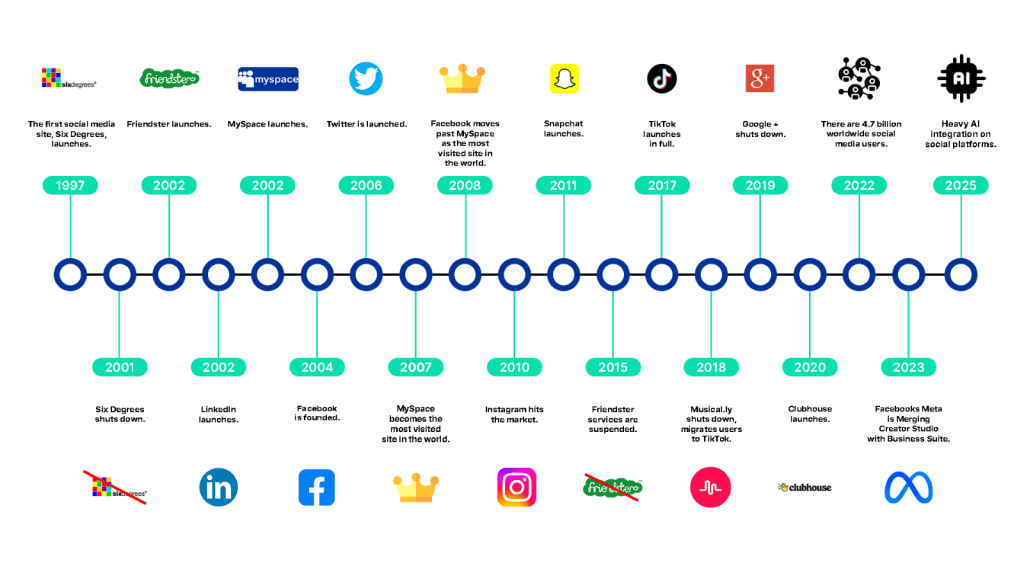
A Brief History of Social Media
From SixDegrees to the Metaverse, explore the history of social media. Understand how online communication has evolved over the last three decades.

Meta Platforms (formerly Facebook): A Corporate History
Learn about Meta Platforms, the parent company of Instagram, Facebook, and WhatsApp. Understand its expansion and pivot to the metaverse.
Comments
Notes are saved only in this browser (local storage). They are not sent to a server.
Comments
Loading…