A Brief History of Social Media
From SixDegrees to the Metaverse, explore the history of social media. Understand how online communication has evolved over the last three decades.
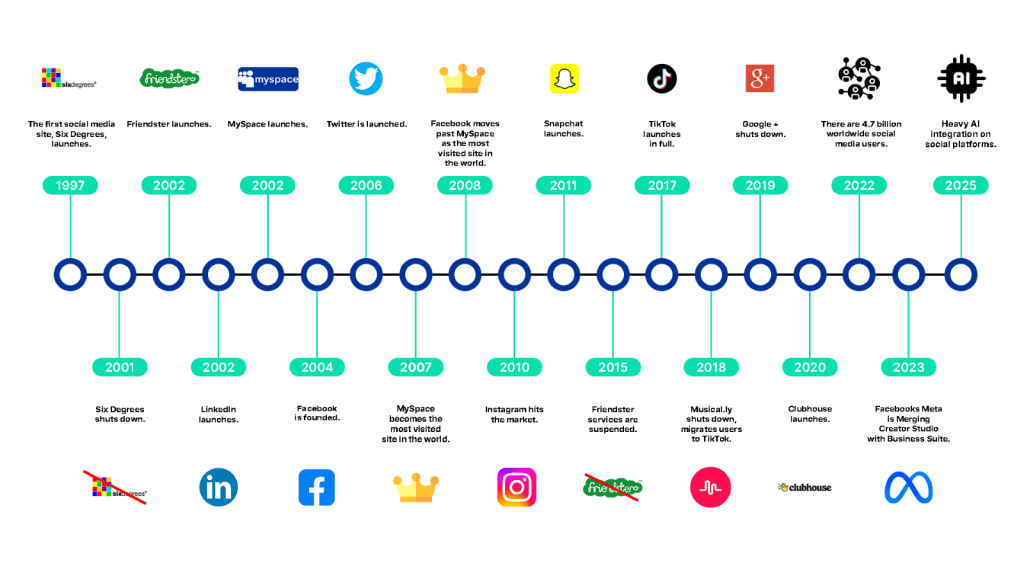
The Evolution of Social Media
Social media are interactive technologies that facilitate the creation and sharing of information, ideas, interests, and other forms of expression through virtual communities and networks.
Early Days (1990s)
- SixDegrees.com (1997): Often cited as the first social media site. It allowed users to create profiles and list friends.
- Blogging: The late 90s saw the rise of blogging sites like LiveJournal and Blogger, allowing users to publish their thoughts online.
The Golden Age (2000s)
- Friendster (2002): A pioneer in social networking, it allowed users to contact other members and share content.
- MySpace (2003): Became the most popular social networking site in the world from 2005 to 2008. It was known for music integration and customizable profiles.
- Facebook (2004): Launched by Mark Zuckerberg at Harvard. It initially required a university email address but eventually opened to everyone, dominating the market.
- LinkedIn (2003): Focused on professional networking.
- Twitter (2006): Introduced microblogging with a 140-character limit.
The Visual Era (2010s)
- Instagram (2010): Focused entirely on photo sharing and filters.
- Pinterest (2010): A visual discovery engine for finding ideas like recipes, home and style inspiration.
- Snapchat (2011): Introduced ephemeral messaging (content that disappears).
The Video Era (2015-Present)
- TikTok (2016): Popularized short-form video content with music and algorithmic personalization.
- Clubhouse (2020): Focusing on audio-only content.
Impact on Society
Social media has fundamentally changed how we communicate.
- Political Changes: Played a key role in movements like the Arab Spring and #BlackLivesMatter.
- Marketing: Created a new industry of digital marketing and influencers.
- Mental Health: Raised concerns about cyberbullying, anxiety, and body image issues.
Share this article
Related Articles
How to Grow Instagram Followers Organically in 2025: Complete Guide
Learn proven strategies to grow your Instagram followers organically in 2025. No bots, no fake followers - just real, actionable tips that work. Build an engaged audience the right way.
The Complete Timeline of Instagram: From Launch to Today
Trace the evolution of Instagram from its launch in 2010 through major milestones like the Facebook acquisition, introduction of Stories, and Reels.
Influencer Marketing: Definition and History
What is influencer marketing? Learn how brands use social media personalities to promote products and how this industry has grown into a billion-dollar market.
Comments
Notes are saved only in this browser (local storage). They are not sent to a server.
Comments
Loading…